Around 80% of AI integration efforts failed in the first wave, back in 2024, and they still fail today. Things go wrong in three distinct ways, and leaders struggle with a number of urgent questions: is my organization ready? Is the training I’m investing in what my community needs? Is it working? Those questions are rarely answered by most training companies. The solution is the AI Readiness Scan, a “living” diagnostic audit that mirrors where an organization actually stands across three pillars, and keeps on reflecting the state of progress along the way.
Fiona Passantino, September 2026
You’re the leader of a complex organization. You are planning your journey of large-scale AI integration with broad, baseline AI literacy for all hands. You know you’re taking on something big, but you’re not quite sure just how big. A towering mountain rises ahead of you, with so much you don’t understand, and the mental cost ticker is spiraling ever upwards as proposals from AI training organizations roll in.
Some key questions start filling your mind. None of them appear to be answered by the consultants you’re talking to.
- Is my organization even ready for an AI transformation?
- Is the data, the people, the leadership in the right place?
- Do we need to “do the (pre) work”, to become ready?
- How do I know if the training I’m about to invest in is actually what we need?
- How do I know if it’s working, and adapts to our needs over time?
- How do I know if it takes my business context into account?
About 80% of AI Integration efforts failed during the first wave in 2024.[i] When large-scale AI transformation flops, it does so in three completely different ways: across Tech, People and Policy.
The AI Readiness Audit is a diagnostic tool that takes an honest photograph of where an organization actually stands with AI before any training starts. The scan measures AI Readiness across the three key areas.
Tech
The engine behind the AI transformation, the “tech” pillar covers technology, data, access, data infrastructure, data management, connectors, MCPs, APIs, technical teams, hardware and software, IT, ICT, tools, licenses and security. The aim is to prepare the organization for process automation and, where relevant, for a future-proof sovereign AI environment. The “tech” pillar focuses on:
- AI tools & access
- Data quality & data management
- System integration
- Technical flexibility
- Hardware & software
- Security & technical compliance
- Scalability: from pilot to organization-wide application
Human
The “Human” pillar is the one most organizations underestimate, and is often invisible, and seen only by HR workers. Even with the best premium licenses and perfect data, if the people resist, no integration is possible. Humans who are untrained, unsupported, unconvinced, or quietly telling themselves that they are adopting the tool that will one day replace them, nothing moves.
AI Integration is an all-hands undertaking, from the factory floor to the top-floor boardroom. All of them have to have the confidence, support, psychological safety to invest in their own AI education. Humans need time and space to experiment with this new way of working; to fail, change their mindset, workflows and team composition without the expectation that they are going to become 40% more efficient the day after their first training.
The “Human” pillar covers management, culture, transparency, resistance and psychological safety as well as AI attitude and general baseline AI skills. The key measurement areas are:
- Psychological safety
- Leadership
- Engagement
- Resistance and readiness for change
- Communication
- Transparency
- Confidence in one’s own ability (AI confidence)
Policy
The third way has to do with vision, policy and ownership, which is a hard truth for most high-level leaders to hear. Early AI integration saw CEOs handing off to IT teams to let them run the circus, since “AI sounds like a tech thing”. They quickly found that the IT guys are not excited about letting people experiment with AI, since their heads are on the block with the first data leak or internal agent hack. They are not interested in seeing untapped business opportunities AI can deliver. Those same excellent, hard-working IT guys do not always have the skillset needed to train, sell, convince and explain the vision of AI Integration to the people.
That’s your job.
Policy and leadership are the steering wheel of the AI transformation, where strategic goals on efficiency, quality and effectiveness live. It all starts with clear governance and ground rules exist for responsible AI and data use, who holds ownership, what a sustainable change budget is, and whether employees have the knowledge and skills to apply what they learn effectively. The key measurement areas are:
- Vision and objectives: the why, how and what of deployment frameworks
- Leaders’ own level of AI literacy, theoretical and practical
- Communication, transparency, role-modelling and ownership frameworks
- AI training approach development of employees, suppliers and dealers
- AI strategy and KPIs, change management and implementation
- AI Excellence Group and policy development for action and licensing
- AI ethics, morality and responsible use around models and agents, bias, privacy
- Regulation and compliance: EU AI Act, GDPR and European Guiding Principles
- Sustainable AI: cost, energy, growth and structural embedding
The Audit
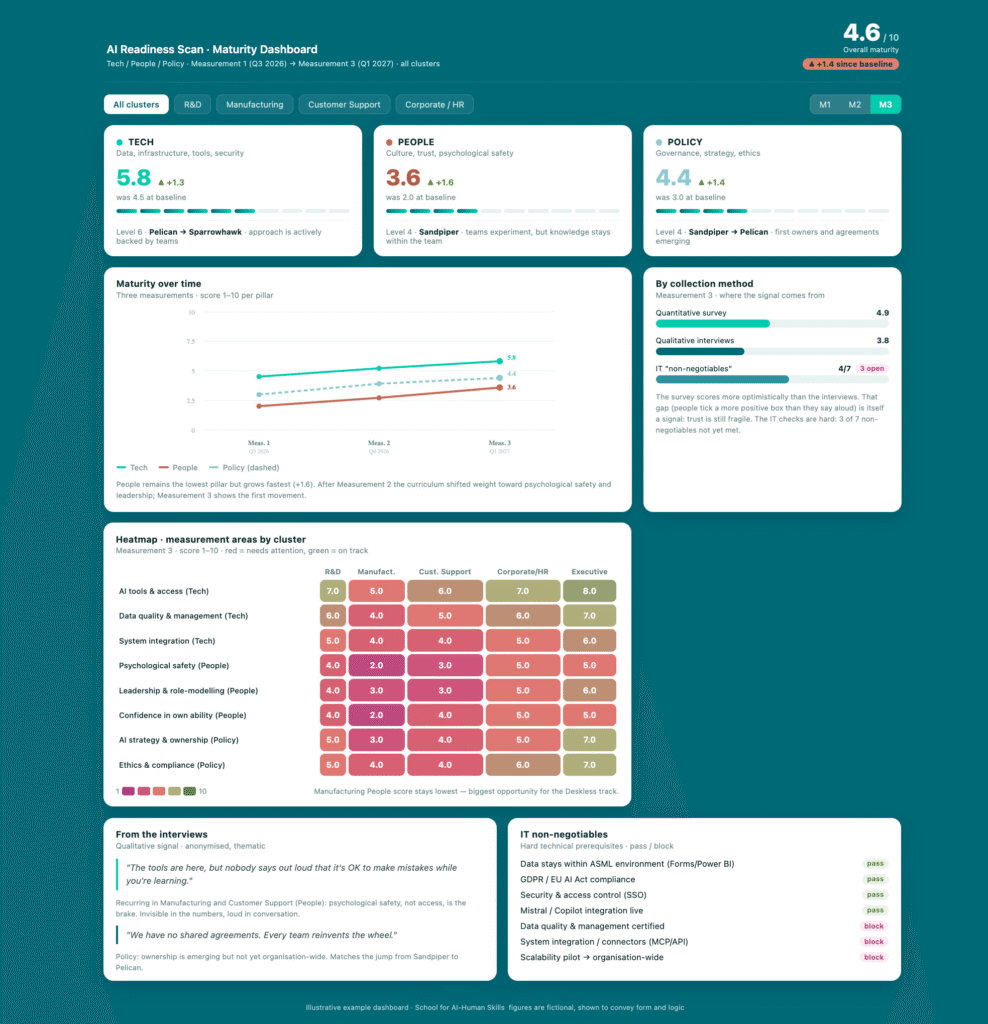
The baseline and subsequent measurements consist of a combination of anonymous surveys, spot-check stakeholder interviews and non-negotiable organizational data. The results are translated into a segmented AI maturity score comprised of heatmaps per business unit, and a practical roadmap with prioritized recommendations. This creates a snapshot of the organization at a moment in time, an objective starting point.
And then we repeat every six months, taking that same photograph at regular intervals, telling you where you are on the roadmap and whether you’re actually getting somewhere. The Audit becomes a living, shifting reflection, mirroring the transformation journey, pointing out where the training is working, which areas are underserved and which are thriving, and guides the training as learning modules are built “on-the-fly”
“On-the-Fly” Training
What does “on the fly” module build mean, and why is it an essential part of the transformation? Any AI training organization that does not create custom AI training material that is necessarily keeping pace with the rapid changes in AI, that is fitted to your business context, is not worth your time. AI training is not evergreen, like “business presentation skills” or “effective communication”, which we have been working on ever since the first granary opened its doors in the village marketplace, for millions of years.
Sure, “off the shelf” online AI modules are cheap and scalable and make you feel like you’re doing something meaningful. But you will be exposing your employees to material that is, by definition, outdated and too generalized to work for your specific business area. You are asking your employees to do a lot of heavy lifting, make those massive leaps to adapt what they learn to their workflows, as well as practice and experiment on their own.
Framework
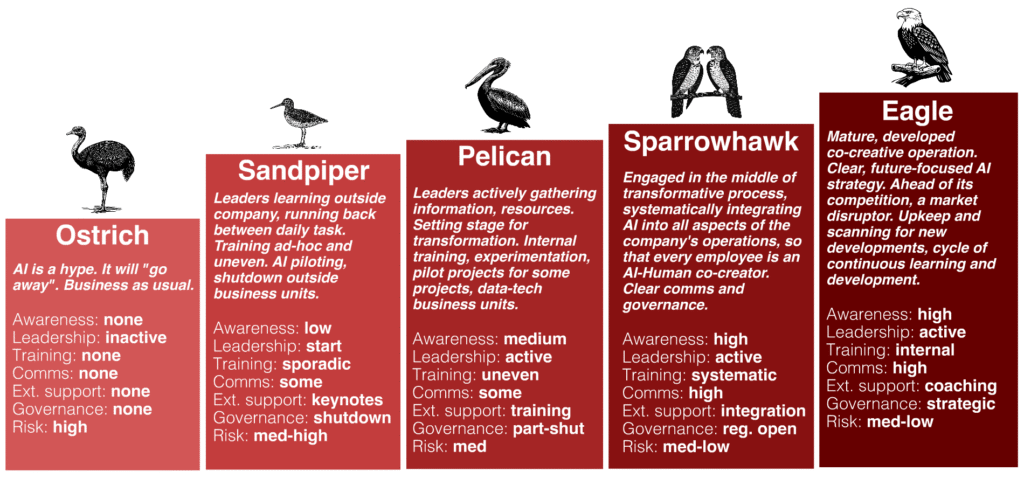
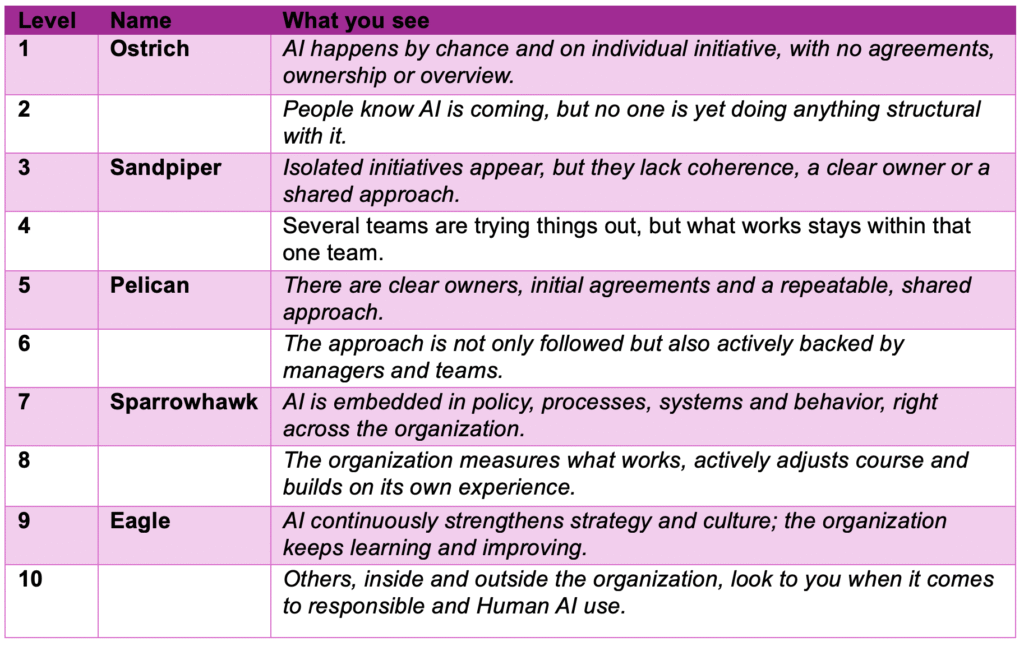
Each pillar is designed, developed and guided by an experienced professional with expertise in the domain concerned. This establishes an organic maturity level, ranging from level 1 (ad hoc) to level 10 (leading). The “Bird-based AI Maturity Matrix” is a nice way to visualize organizational AI readiness: which bird matches the current levels of maturity and which does it want to become?[ii]
A lower maturity level is not a judgement, but a starting point for focused development. Some areas may deliberately remain at level 2 or 3 where this fits the current phase and strategic priorities
Readiness in Motion
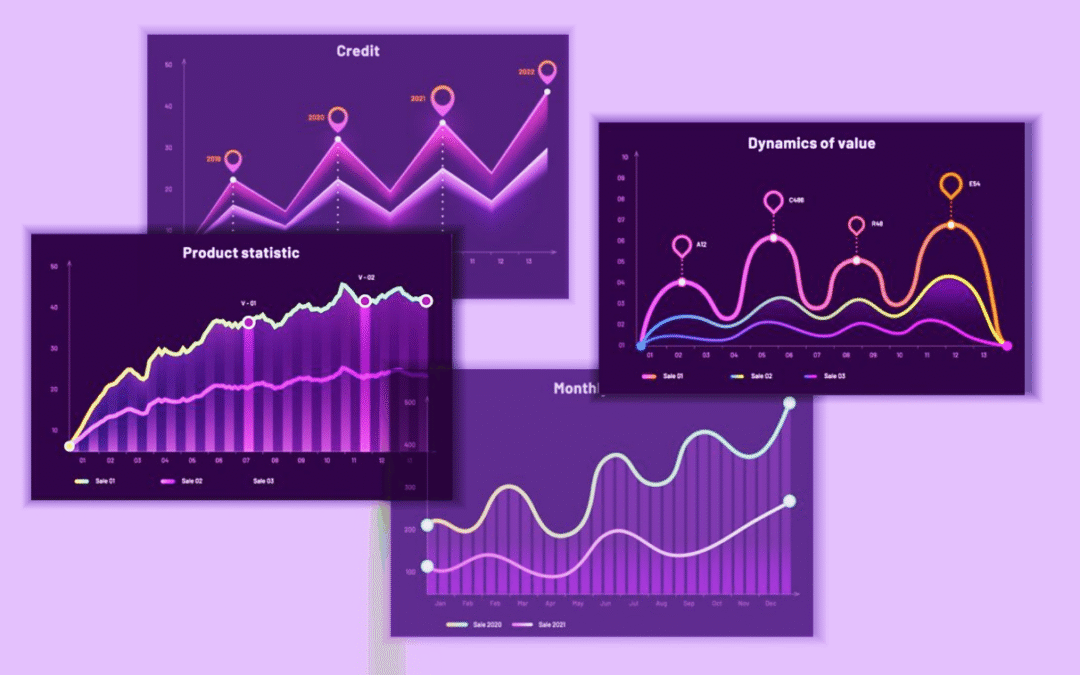
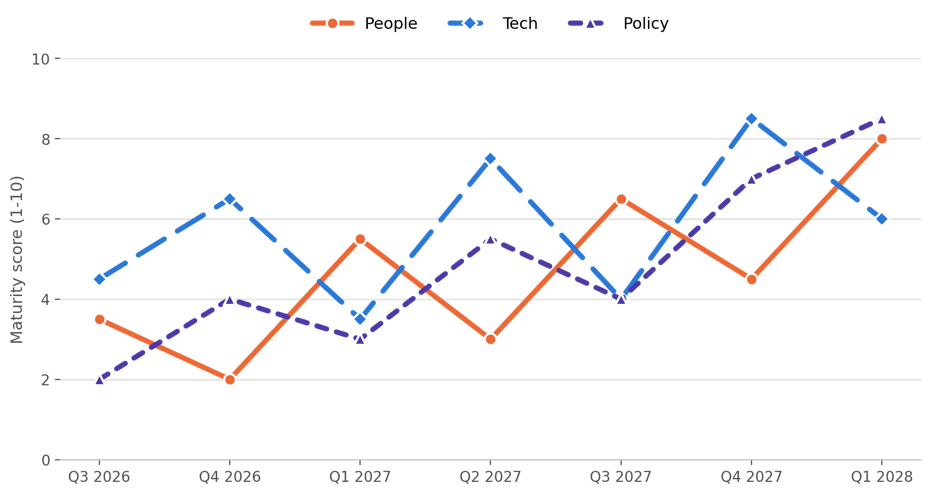
What does this “organic” readiness pulse look like over time? This is an example of how the three pillars of the AI-Readiness Scan could move over the course of the transformation as the initial AI baseline literacy fades in the rear-view mirror, and the more technical training ramps up. As “tech” lines dip, this signals to the trainers and leaders that more attention needs to be paid to data readiness, infrastructure and platforms. As “Human” lines surge, leaders know their people are ready to take on the next challenge. Trainers know where to focus attention, finetune exercise, adjust the training, communication and implementation accordingly.
Nobody sane starts climbing the AI mountain without first checking the weather, the gear, and whether the people roped in behind them can actually walk. The Audit is that check. It won’t make the mountain smaller, but it will tell you exactly where you stand, which parts of your team are ready to climb and which need better boots, and whether the path you’re on is right for your business.
AI Readiness Audits give you the assurance that you’re doing integration right from the start. That this “rightness” continues over time as training and transformation unfolds. It will mean your organization will be among the handful who make it to the top and can appreciate the view where eagles fly, eyes on the horizon.
Need help with AI Integration?
Reach out to me for advice – I have a few nice tricks up my sleeve to help guide you on your way, as well as a few “insiders’ links” I can share to get you that free trial version you need to get started.

No eyeballs to read or watch? Just listen.
Working Humans is a bi-monthly podcast focusing on the AI and Human connection at work. Available on Apple and Spotify.

About Fiona Passantino
Fiona helps empower working Humans with AI integration, leadership and communication. Maximizing connection, engagement and creativity for more joy and inspiration into the workplace. A passionate keynote speaker, trainer, facilitator and coach, she is a prolific content producer, host of the podcast “Working Humans” and award-winning author of the “Comic Books for Executives” series. Her latest book is “The AI-Powered Professional”.
[i] Ryseff, De Bruhl, Newberry (2024) “The Root Causes of Failure for Artificial Intelligence Projects and How They Can Succeed: Avoiding the Anti-Patterns of AI” RAND National Security Research Division https://www.rand.org/pubs/research_reports/RRA2680-1.html
[ii] Passantino (2025) “The Bird-Based AI Maturity Matrix” from “AI-Powered Leader” published by Working Humans Press https://www.amazon.nl/dp/B0GZV6FYR9